Food Forests and Natural Building
Our big brains and hands are meant to serve mother earth, not dominate it.
While most people were baking sourdough and watching Netflix during the covid lockdowns, I was streaming permaculture videos. I became obsessed with Kirsten Dirksen’s work documenting places like Occidental Arts & Ecology Center (OAEC) in Northern California and Andrew Millison’s garden in Oregon. It took me 5 years, but last week I finally made it to a food forests course at OAEC, and my YouTube fantasy became a reality.
Highlights from my notebook
- Foresting is a verb
- Restoration is forward looking, not back
- Ecotones, edges, diversity
- Placement, structure, function
- Patterns & relationships
- Access & pathways first
- Plan succession so you are not needed
- Block, channel, unblock, but you can't make flow go away (wind, water, etc.)
- With consensus, not "does everyone agree" but "can you live with it"
- Principles & values > physical form
- Designing ecosystems, not farms
The first day was focused on land acknowledgement, and I was immensely moved by a visit from Lyla June. She spoke about indigenous regenerative systems, explaining that humans have the potential to be a keystone, an asset, and a catalyst for the land rather than a pest or plague. I’m paraphrasing from my notes, but her words hit me harder than expected: our big brains and hands are meant to serve mother earth, not dominate it. That message of unity broke through the resistance I had taken on from being educated and conditioned in a capitalist culture. She lit a fire in me to put my own skills to work in service of the earth.

The rest of the week was incredible. Most mornings began outside with a “sit spot” for meditation, fully immersed in the landscape. We practiced creating food forest designs, then worked together digging a swale, carving a path, planting trees, and sheet mulching the steep south facing slope. The course covered integrated pest management (IPM) and plant propagation along with crucial subjects like ecological governance and food preservation. Time in the classroom was balanced out with a mushroom log workshop in the greenhouse and breaks to swim in their natural pond. Huge thanks to Brock, Timo, Red Bird, Anniema, and everyone in the community at OAEC!
Notebook, continued
- Software > hardware
- Guardian vs ruler
- Topography creates opportunity & diversity
- Water storage, not shortage
- Phenology, watching natural rhythm
- Process Based Restoration (PBR) in ways imagined and unimagined
- Guilds and layering, more a process over time than a yield
- Aim for quality of relationships, not number of elements
- Borrow earth for food forests. Who will take care of it after you?
- Memories are planted, that is teaching!
- Not just plant communities. Planting communities.
As luck would have it, right after I got back the Humboldt Permaculture Guild put on a fantastic workshop on light straw clay construction with Steve and Trudy from Adventures in Permaculture. It was the perfect way for me to bring the food forests course home, pairing what I learned about growing food with the hands-on craft of building shelter from the earth itself. Getting my hands muddy alongside neighbors also wove me into the local permaculture scene. That sense of belonging to land and people is exactly what I am looking for right now, wherever I end up planting roots.
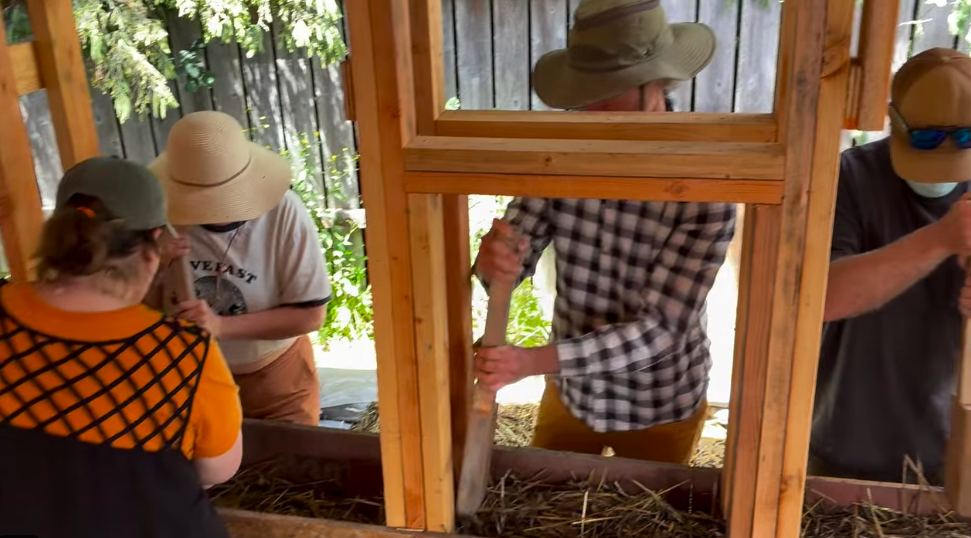
For me, these weren’t two separate events but one continuous experience of living a more interconnected lifestyle. At OAEC, it was so healing to share a flat with rad housemates and team up with 30+ like minded people doing earthworks before a communal meal. Back in Humboldt, we came together to build a natural house, the first of its kind in the county, leaving a trail of innovation that others can follow. Kendall from OAEC said, “it’s hard to imagine something you haven’t seen before,” and I finally got to see the real thing.